





Working Paper · Dunster Series
A numbered entry in the Dunster Working Paper Series, deposited on SSRN. Clean exposition, robustness, public-facing scholarship.
A 6 to 24-month advanced research fellowship for newly-minted doctorate holders ready to publish, present and position themselves as recognised researchers. Independent agenda, named Senior Research Mentor, publication pipeline and supervisor matching from Dunster Business School. From application to admission, research to recognition - we're your partner.

Publication pipeline · Fellowship community
Post-Doc Fellowship · Linkway × Dunster


Post-Doctorate Fellowship · Research-Driven · ACBSP Cand. · QS 4-Star (2025)
Duration
Research Streams
Senior Mentor
Submission Targets
Click any reason - the panel updates without scrolling.
Dunster Business School is an ACBSP candidate, QAHE accredited, QS 4-Star rated and Bologna ECTS-aligned. Your Fellowship sits within a formal, internationally benchmarked research framework, not a self-styled programme. Same Degree as On Campus.
Personalized mentorship from expert research guides. Pick a primary stream, collaborate on a secondary - and let supervisor matching pair you with a named PI.
Track 01 of 08
Competitive dynamics, capabilities and firm performance in turbulent markets.
Core Modules
Career Roles
Tools You'll Use
Want to compare two specialisations or talk through which fits your strengths? A 30-minute advisor call covers it.
No fluff semesters - guided dissertation and research mentorship from Day 1. Hover or click any phase to expand what gets taught and shipped.
Lock the question, the contribution and the route to publication. Mentor kickoff, literature audit, gap statement, refined research question, pre-registered methodology, ethics clearance where relevant.
Ships This Year
Research Proposal v2 + methodology pre-registration + work plan
Field Research
Writing, Submission & Publication
Year 01 · Onboarding
Onboarding & Agenda Setting
Lock the question, the contribution and the route to publication. Mentor kickoff, literature audit, gap statement, refined research question, pre-registered methodology, ethics clearance where relevant.
Ships
Research Proposal v2 + methodology pre-registration + work plan
Year 02 · Field Research
Field & Empirical Research
Year 03 · Writing, Submission & Publication
Writing, Submission & Publication
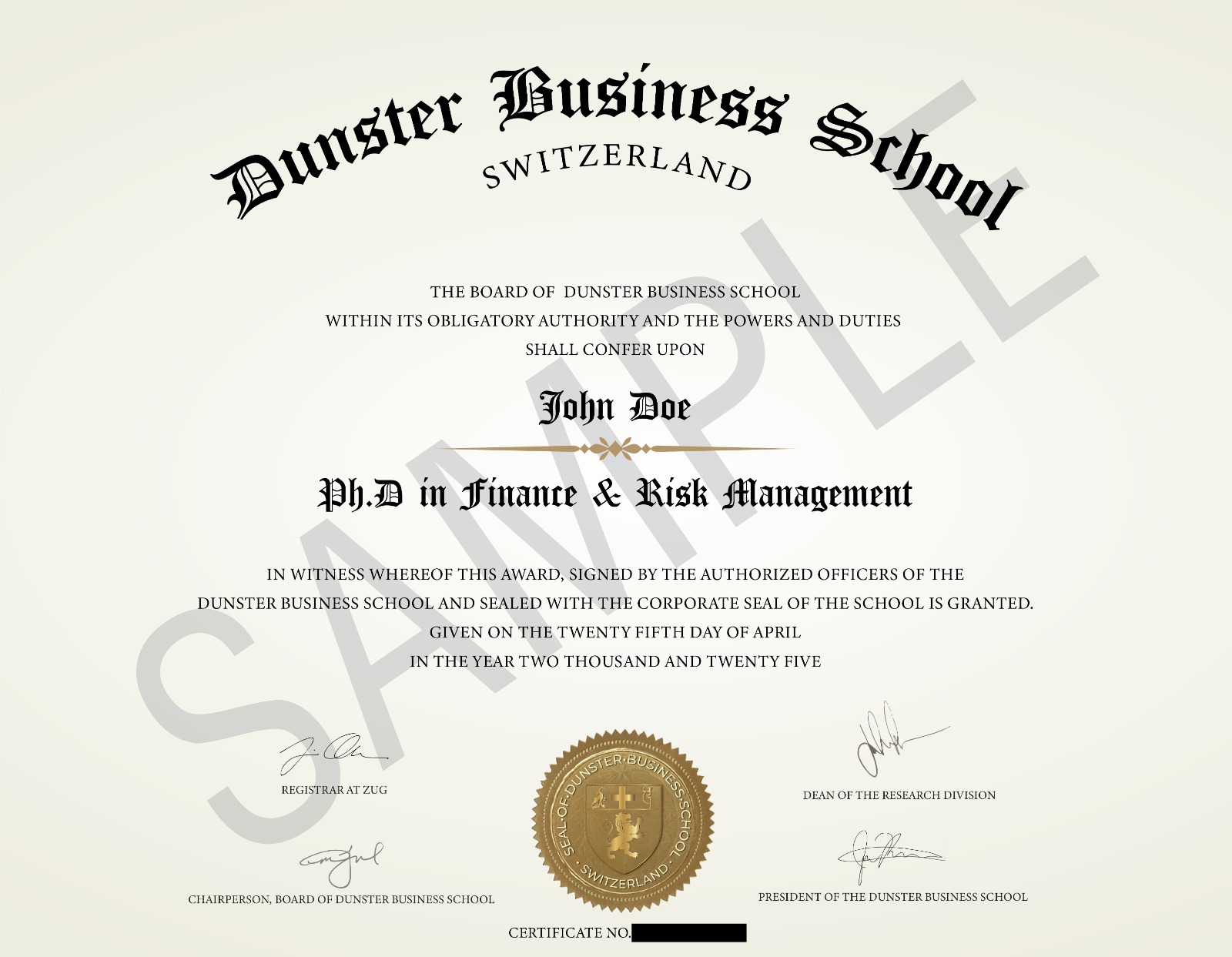
The Post-Doctorate Fellowship Certificate is awarded by Dunster Business School on successful completion of the agreed research deliverables and Senior Mentor sign-off. ACBSP candidate, QAHE accredited, QS 4-star rated and Bologna ECTS-aligned. Includes a Letter of Recognition from your Senior Research Mentor - a named principal investigator in your stream.
Issued by
Dunster Business School


Writing and reference in Phase 1, quantitative and qualitative analysis through Phase 2-3, and dissemination plus indexed publishing platforms to take work from working paper to journal acceptance and scholarly visibility.
You won't touch every tool here - your method and discipline choose the depth. Reference managers and writing platforms start in Phase 1; analytical packages and indexed databases come in as your manuscript demands.
Each phase culminates in a peer-reviewed deliverable a tenure-track committee or journal editor can actually open and evaluate. Research aligned to industry needs.
A numbered entry in the Dunster Working Paper Series, deposited on SSRN. Clean exposition, robustness, public-facing scholarship.
A focused paper accepted to a recognised conference track, including discussant engagement. Abstract writing, presentation, scholarly debate.
Conference paper · discussant role
A single-study, theory-contributing manuscript submitted to a target ABS / Scopus-indexed outlet in your stream. Theoretical framing, research design, peer-review craft.
Journal submission · ABS / Scopus target
The Finale
04
Capstone
A long-form synthesis - either a sole-authored monograph or a contributed chapter in a Dunster-Linkway edited volume. Synthesis, narrative, book-length argumentation.
Four mentor layers, indexed below - each tagged with the precise years they're in play. From Week 1 of Year 1, through the capstone build, you're never working alone.
Methods specialist signing off rigour at each phase gate.
Two to three full-time academics in your stream - reviewers and discussants.
Research-oriented practitioners keeping your work field-tested.
Named principal investigator. Fortnightly 1:1s. Letter of Recognition at completion.
The Dunster-Linkway Post-Doctoral Fellowship community at work. The moment our Fellows step from candidate to scholar - letter of recognition signed, working papers deposited, peer-reviewed manuscript submitted, next chapter open.

Manuscript pages · Letter of Recognition signed
Where research meets recognition

Working paper deposited · paper under peer review
From candidate to scholar

Phase 4 · Submission complete
Publication pipeline · Fellowship community

Named principal investigator · Q1 journal target
Senior Research Mentor signature on certificate

Visiting professor and senior researcher offers next
Tenure-track preparation
Working paper deposited to SSRN. Conference abstract accepted. Internal Dunster seminar delivered. First peer-reviewed submission under review.
One to two peer-reviewed submissions, a conference paper, a Dunster Working Paper number, a Letter of Recognition from the Senior Mentor, and a portfolio for academic or industry placement.
Tenure-track or visiting faculty offer, named Visiting Fellow appointment, senior research advisor role with a firm, or research-led consulting practice with publication output.
Recognised body of work, journal editorial board membership, professor-of-practice appointment, doctoral supervisor at a partner institution, or principal investigator on a funded research programme. Industry-academia bridge roles teaching, mentoring, and supervising research.
Illustrative student journeys - your real story may look like this.
“The Fellowship gave me the time and the mentor I never had during my PhD at Oxford Saïd. My working paper became my first SMJ acceptance within fourteen months - and the offer from Wharton followed two months later.”
“I came in with data from my desk at a hedge fund and no theoretical hook. The methods advisor reframed the entire study. The output is now under review at the Journal of Finance and my new role at BlackRock cited it explicitly.”
“The publication coaching is the differentiator. I learned to write for journal reviewers at JMR, not just for thesis committees. Three of my Fellowship papers are now in second-round review.”
“My mentor pushed me to publish the code and the dataset alongside the paper - real open-science practice. That single decision opened the INSEAD visiting role I now hold.”
“I had twenty years of fieldwork at the Bank of England and zero peer-reviewed publications. The Fellowship taught me to convert policy practice into scholarly argument that LSE took seriously enough to give me a Professor of Practice chair.”
“The innovation-ecosystem report I built during Phase 2 became the seed of the policy programme I now run at Brookings. The Fellowship sharpened the methodology that made the report defensible.”
“Three rounds of peer review and a published JMS paper in under two years. The structure made the difference - by the time I came up for editorial-board invitations my publication CV was already there.”
“I now sell strategy work backed by my own published research. That repositioned my entire practice - HBR cited one of my Fellowship papers last quarter and a Fortune-500 CEO called me the next week.”
“The Fellowship gave me a credible international platform for ESG-disclosure research that FTSE boards take seriously. My TCFD-implementation framework is now embedded in AstraZeneca's sustainability reporting.”
“A focused twelve-month fellowship was exactly the right length to ship one strong paper for Health Affairs and one applied policy brief that the Harvard Chan School cited in their fall-cycle decision.”
“The cross-cultural methodology track was tailored to my US-UK comparative work, not generic. I left with three datasets, a paper pipeline at JIBS, and a BCG senior-knowledge-leader offer.”
“The monograph I started in Phase 4 of the Fellowship is now my first Wiley-published book. Two HBR articles followed. The Fellowship was the bridge from executive practitioner to publishing academic.”
“The Fellowship gave me the time and the mentor I never had during my PhD at Oxford Saïd. My working paper became my first SMJ acceptance within fourteen months - and the offer from Wharton followed two months later.”
“I came in with data from my desk at a hedge fund and no theoretical hook. The methods advisor reframed the entire study. The output is now under review at the Journal of Finance and my new role at BlackRock cited it explicitly.”
“The publication coaching is the differentiator. I learned to write for journal reviewers at JMR, not just for thesis committees. Three of my Fellowship papers are now in second-round review.”
“My mentor pushed me to publish the code and the dataset alongside the paper - real open-science practice. That single decision opened the INSEAD visiting role I now hold.”
“I had twenty years of fieldwork at the Bank of England and zero peer-reviewed publications. The Fellowship taught me to convert policy practice into scholarly argument that LSE took seriously enough to give me a Professor of Practice chair.”
“The innovation-ecosystem report I built during Phase 2 became the seed of the policy programme I now run at Brookings. The Fellowship sharpened the methodology that made the report defensible.”
“Three rounds of peer review and a published JMS paper in under two years. The structure made the difference - by the time I came up for editorial-board invitations my publication CV was already there.”
“I now sell strategy work backed by my own published research. That repositioned my entire practice - HBR cited one of my Fellowship papers last quarter and a Fortune-500 CEO called me the next week.”
“The Fellowship gave me a credible international platform for ESG-disclosure research that FTSE boards take seriously. My TCFD-implementation framework is now embedded in AstraZeneca's sustainability reporting.”
“A focused twelve-month fellowship was exactly the right length to ship one strong paper for Health Affairs and one applied policy brief that the Harvard Chan School cited in their fall-cycle decision.”
“The cross-cultural methodology track was tailored to my US-UK comparative work, not generic. I left with three datasets, a paper pipeline at JIBS, and a BCG senior-knowledge-leader offer.”
“The monograph I started in Phase 4 of the Fellowship is now my first Wiley-published book. Two HBR articles followed. The Fellowship was the bridge from executive practitioner to publishing academic.”
No strict deadlines. We run advisor calls week-round and match you to the next available cohort. End-to-end guidance from application to admission, research to recognition.
Submit short EOI with research stream and proposed question. ~15 minutes online.
30-minute call with an academic advisor - track fit, eligibility check, format choice, and fee structure walkthrough.
Documents reviewed by the admissions team and a Dunster faculty representative.
If admitted, you receive a conditional offer letter - track, intake date, and financial details.
Acceptance, enrolment, advisor matching, cohort onboarding. Year 1 begins.
Who it's for
Designed for newly-minted doctorate holders aiming at tenure-track or senior research positions.
Fees & financing
Exact fee structure, scholarship, EMI and aid pathways shared during the advisor call.
Straight answers. No corporate fluff.